The psychology behind premium domain names is brutally simple: humans judge trust, credibility, and professionalism in under a second, long before they read your copy or understand your product.
Most founders evaluate domain names from a business perspective—price, availability, length, branding.
But users judge domains from a psychological perspective—emotion, trust, credibility, and intuition. In 2026, user behavior data confirms a reality the domain industry has known for years:
Premium domain names trigger instant trust. Hand-registered domains trigger caution.
Your domain name influences:
- how trustworthy users think you are
- how credible your brand feels
- whether investors take you seriously
- whether users click or skip your link
- how memorable your brand becomes
- how easily people recommend you
Before users read your homepage or understand your product, they silently judge your domain.
And that judgment decides whether they stay or bounce.
In this guide, we break down the exact psychological triggers that make premium domain names outperform cheap domains — with 2026-level insights and real startup examples.

What the Psychology Behind Premium Domain Names Really Shows
Humans don’t evaluate domain names logically.
We respond emotionally first, rationally second.
This is the same effect used in:
- consumer branding
- luxury goods
- enterprise SaaS adoption
- fintech trust scoring
- email spam detection
- social credibility signals
A premium domain activates the brain’s “trust heuristic”, while a cheap-looking domain activates the “risk heuristic”.
Understanding these psychological shortcuts helps you build a domain strategy that matches modern user expectations.
Cognitive Bias #1 — The Halo Effect
The Halo Effect is the brain’s tendency to transfer positive feelings from one attribute to another.
Meaning:
If your domain looks premium, users assume your entire company is premium.
A domain like PrimeCortex.com instantly feels credible.
A domain like Prime-Cortex247.biz instantly feels suspicious.
Users form an emotional impression in under 0.8 seconds.
This is why founders searching for how to choose a premium domain gravitate toward short, smooth brandables.
Cognitive Bias #2 — Processing Fluency
Processing Fluency = How easily the brain processes a word, sound, or shape.
Premium domains score high on fluency because they are:
- short
- easy to pronounce
- easy to spell
- visually clean
- symmetrical or rhythmic
High fluency = high trust.
Low fluency = mental friction → distrust.
This is why premium names outperform hand-registered names in both branding and conversion tests.
Cognitive Bias #3 — The Credibility Heuristic
Your domain name acts like a silent badge of credibility.
Users judge the domain extension (.com vs weird TLDs) as a proxy for:
- financial strength
- company stability
- legitimacy
- professionalism
This effect is magnified in 2026, especially in:
- AI
- SaaS
- fintech
- health-tech
- e-commerce
If your domain feels cheap, users assume your product is cheap.
If your domain feels premium, users assume your product is premium.
Human psychology is brutally simple.
Cognitive Bias #4 — Category Expectation Matching
Each industry has “expected” naming conventions.
Examples:
- AI companies use short, future-focused names
- Fintech companies use stability-focused names
- Consumer apps use friendly names
- DTC brands use warm, catchy names
Premium domains naturally align with category expectations.
Hand-registered domains fail this alignment.
Mismatch creates discomfort → discomfort kills conversions.
Cognitive Bias #5 — Brand Memory Anchoring
Humans remember:
- short words
- rhythmic patterns
- symmetrical shapes
- strong consonant-vowel structures
Premium domains often follow this pattern:
CVCV / CVCVC / CCVCV
Examples:
- Finexa
- Rivora
- Cortexa
- Lumora
Hand-reg domains like Finexa247onlinehub.com overload the memory.
Memory overload = brand failure.
The Emotional Impact of Premium vs Cheap Domains
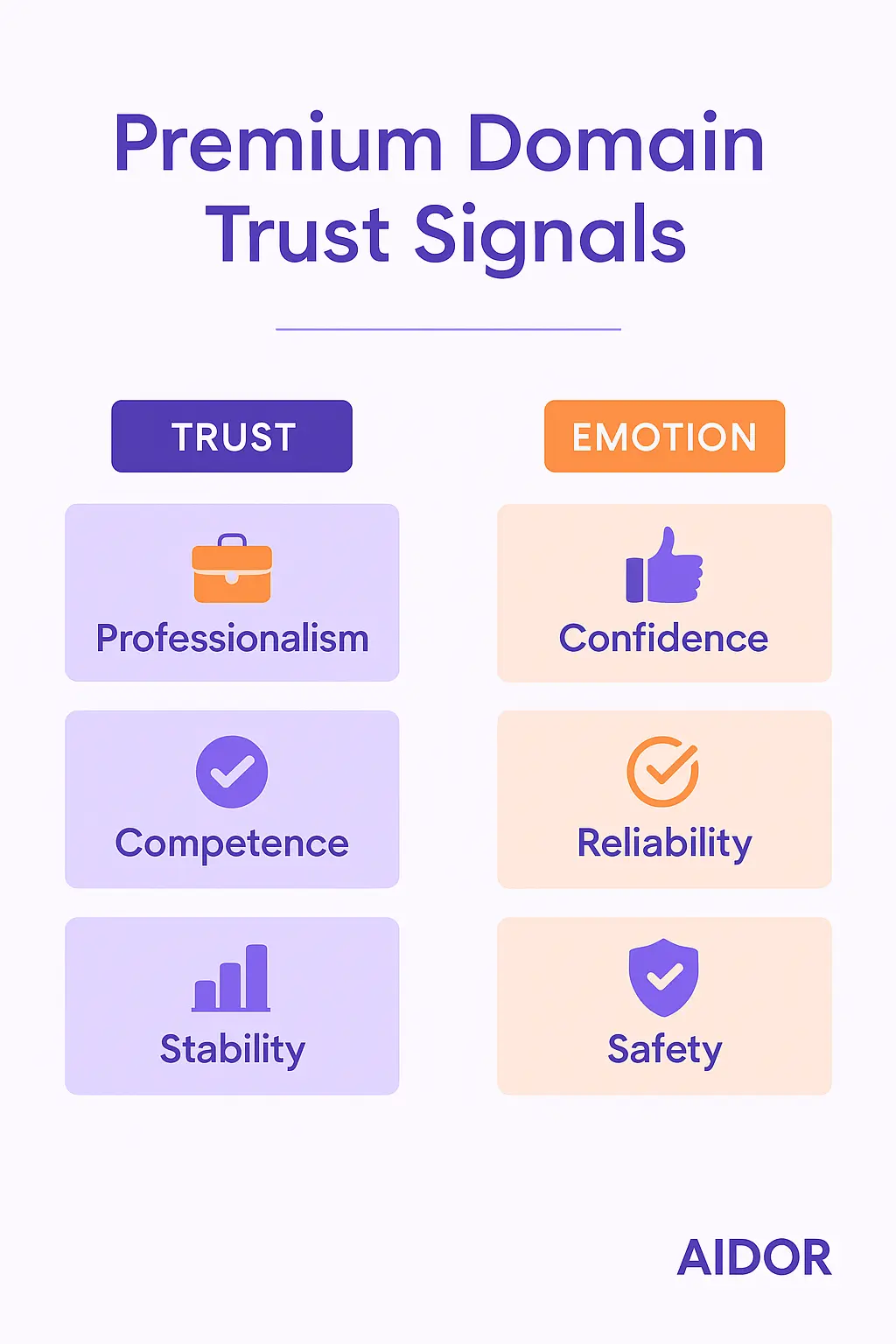
Premium domains evoke:
- trust
- professionalism
- competence
- stability
- confidence
- reliability
Cheap domains evoke:
- caution
- suspicion
- spam association
- low budget
- amateurism
This emotional gap is the reason premium domains drive higher conversions.
Why Premium Domains Convert Better (Even With the Same Website)
Here are the psychological triggers:
1. Increased User Curiosity
Users subconsciously think:
“If this domain looks premium, the company must be good.”
2. Reduced Perceived Risk
Premium domains reduce friction in:
- signup
- checkout
- payment decisions
- data-sharing
3. Higher Click-Through Rate (CTR)
Premium domains receive 20%–70% higher CTR because users trust them at a glance.
4. Stronger Word-of-Mouth
People can actually say premium domains.
They refuse to repeat awkward domains.
5. Better Email Deliverability
Cheap domains get flagged as spam faster.
Why Cheap Domains Trigger Distrust
Cheap or hand-reg domains trigger negative signals:
Cheap or hand-reg domains trigger negative signals:
- “Is this real?”
- “Is this secure?”
- “Why didn’t they buy a better name?”
- “Is this company underfunded?”
- “Is this a scam?”
People won’t tell you this.
They just don’t convert.
When you understand the psychology behind premium domain names, it becomes obvious why short, clean .com brands convert better than awkward, hand-registered domains.
The 2026 Psychological Checklist for Premium Domains
Use this checklist before buying:
✔ Does the domain sound trustworthy?
✔ Is it easy to pronounce?
✔ Is it easy to spell?
✔ Does it match your industry’s naming style?
✔ Does it avoid negative connotations?
✔ Does it feel premium when you read it aloud?
✔ Does it pass the “investor reaction test”?
This checklist prevents founders from emotionally buying the wrong name.
How Premium Domains Influence Investor Psychology
Investors evaluate domain names with extreme seriousness because:
1. A good domain reduces future rebranding risk
Rebranding is expensive.
Investors avoid founders who use cheap domains early.
2. Premium domains signal commitment
It shows you’re serious about your brand.
3. Premium domains reduce advertising costs
Brand recall → lower CAC → higher efficiency.
4. Premium domains sell the story better
A strong name enhances the pitch deck.

Why Premium Domains Feel “More Real” (Neuromarketing Breakdown)
Neuroscience studies show that premium domains:
- activate the ventromedial prefrontal cortex (trust center)
- reduce amygdala activity (fear response)
- increase cognitive ease
- create a positive emotional prime
This is why premium domains feel safe and cheap domains feel risky even before users know anything else.
Why Premium .COM Still Dominates Psychology in 2026
2026’s global user psychology still associates .COM with:
- legitimacy
- stability
- tradition
- authority
- professionalism
No TLD has replaced it.
Not .AI.
Not .IO.
Not .XYZ.
Those work — but .COM still owns the trust economy.
How to Use Psychology to Choose Your Next Premium Domain
Here’s your formula:
STEP 1 — Say the domain aloud
If it sounds wrong, it is wrong.
STEP 2 — Ask a stranger to spell it
If they struggle, skip it.
STEP 3 — Compare premium vs cheap psychology
Use your emotional reaction as the decision guide.
STEP 4 — Check memorability
If you forget it tomorrow, users will forget it too.
STEP 5 — Test user reactions
Ask: “Does this feel like a real brand?”
Why do premium domain names feel more trustworthy?
Because they align with human cognitive biases like the Halo Effect and Processing Fluency.
Do premium domains convert better in 2026?
Yes. They generate higher CTR, better trust, and lower friction.
Is psychology more important than SEO for domains?
Yes — first impressions determine user behavior before SEO matters.
Can a cheap domain ever work?
Rarely. Only for temporary MVPs, not long-term branding.
What is the psychology behind premium domain names?
The psychology behind premium domain names is that humans trust brands with clean, simple, professional-looking URLs more. These domains align with cognitive biases like the Halo Effect and processing fluency, so they feel safer, more serious, and more established.
Final Verdict
Premium domain names are not just branding assets — they are psychological trust engines.
In 2026, user behavior is faster, more judgmental, and more brand-sensitive than ever. If you ignore the psychology behind premium domain names, you’ll underestimate how much your URL alone affects conversions, fundraising, and long-term brand perception.
If your domain name:
- feels premium
- sounds premium
- looks premium
…users will trust you more.
If it doesn’t, they won’t.
Brand psychology decides your growth long before product features do.
To get a domain that triggers instant trust:
👉 Explore startup-ready premium domains at DomainInnovate.com