Domain Name Value: What Makes a Domain Truly Valuable in 2026
In 2026, the concept of domain name value has evolved far beyond keywords, length, or simple automated appraisal tools. Domains have become high-value digital assets—similar to premium real estate—and their worth is determined by branding power, market potential, linguistic structure, scarcity, commercial relevance, and investor demand.
A valuable domain is not just a website address.
It is:
- a brand
- a competitive advantage
- a marketing engine
- a trust signal
- a long-term strategic asset
Yet most people still misunderstand how domain name value is determined.
This guide cuts through the noise and provides a professional, accurate, and up-to-date explanation of what truly increases domain value in the modern market.
Whether you’re:
- buying a domain
- selling a premium asset
- evaluating your portfolio
- rebranding a startup
- trying to understand what determines domain worth
…this is the definitive, complete breakdown of domain name value in 2026.
Table of Contents
What Is Domain Name Value? (2026 Definition)
Domain name value refers to the financial worth and commercial potential of a domain based on brandability, demand, linguistic quality, extension strength, comparable sales, and future market trends.
A domain’s value is shaped by a combination of:
- qualitative factors (brand power, emotional resonance)
- quantitative factors (keyword demand, comparable sales)
- market factors (industry growth, buyer demand)
- strategic factors (use-case potential, scalability)
The key truth:
Domain value is never determined by a single factor.
It is the result of multiple mutually reinforcing attributes.
This is why two similar-looking domains can vary in value from $200 to $20,000.
Why Domain Name Value Matters More Than Ever
Domain names today are:
- investment assets
- brand foundations
- acquisition targets
- valuation multipliers
- digital real estate
- long-term assets that appreciate
Companies are paying record-breaking prices for strong names because:
- online trust is everything
- naming competition is intense
- ad costs are skyrocketing
- branding matters more than features
- direct traffic converts at higher percentages
- strong names feel safer and more “established”
A domain with real value delivers long-term ROI in branding, marketing, and growth.
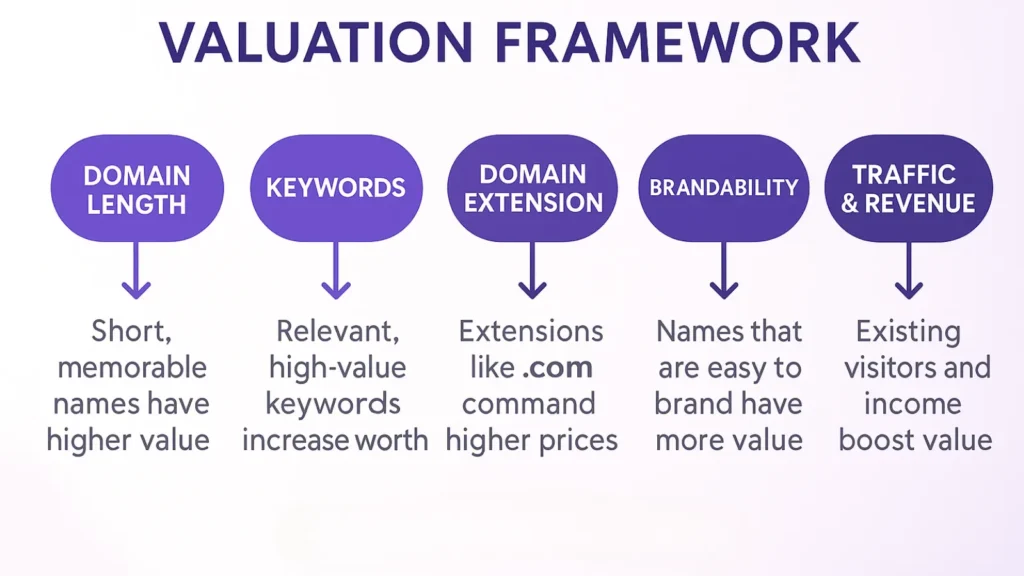
The 12 Core Factors That Determine Domain Name Value
Professional domain valuators (and marketplaces like Atom, Afternic, and premium brokers) use a structured evaluation that covers 12 major factors.
Understanding them lets you predict domain value with accuracy.
1. Brandability (The #1 Determinant of Value)
Brandability is the most important factor in modern domain valuation.
A brandable domain:
- sounds good
- looks good
- feels trustworthy
- has smooth phonetics
- is easy to spell
- is easy to remember
- evokes an emotion or concept
Examples of highly brandable names:
- Stripe
- Notion
- Coinbase
- Figma
- Slack
- HubSpot
Brandable domains consistently sell for:
- $2,000–$7,500 (good quality)
- $7,500–$25,000 (premium)
- $25,000–$150,000+ (elite)
Brandability alone can account for 50–70% of a domain’s total value.
How to Choose a Premium Domain
2. Length (Shorter = More Valuable)
Short domains appreciate faster and sell faster.
Length tiers:
- 3–5 letters: ultra-premium
- 6–8 letters: premium
- 9–12 letters: strong value
- 13+ letters: weaker unless keyword-driven
Shorter = more memorable, more brandable, more expensive.
3. Extension Strength (TLD Value)
The TLD (extension) influences domain value massively.
2026 ranking:
- .com → unmatched value + global trust
- .ai → extremely strong for AI brands
- .io → top choice for tech startups
- .co → decent but secondary
- .org → trusted for non-profits
- country TLDs → depends on region
- new gTLDs → lowest resale value
TLD alone can change value by 50–90%.
4. Keyword Strength (For Certain Industries)
Keywords still matter—especially for:
- finance
- insurance
- legal
- real estate
- health
- home services
High-value keyword domains can reach $10k–$150k+ depending on demand.
But brandable names dominate in:
- AI
- SaaS
- B2B tools
- consumer apps
Premium Domains vs Hand-Registered Domains
5. Industry Demand
Domains are more valuable in trending or high-growth verticals.
2026 high-demand industries:
- AI
- automation
- cybersecurity
- finance & fintech
- crypto infrastructure
- productivity SaaS
- telehealth
- e-learning
- sustainability & climate tech
A domain aligned with an exploding industry automatically increases in value.
6. Trend Alignment & Future Relevance
Forward-compatible domains appreciate the most.
Examples:
- “AgentFlow” → AI Agents BOOMING
- “NeuroLogic” → neurotech emerging
- “GreenGrid” → climate tech scaling
- “PulseAI” → AI healthcare
Domains aligned with future trends create buyer competition.
7. Comparable Sales (Comps)
Real-world comparable sales are the backbone of accurate domain value estimation.
Sources:
- NameBio
- Atom premium sales
- Afternic
- private sales
- wholesale market ranges
If similar names sold for $4,000–$12,000, your domain falls within that band.
How Much Should You Pay for a Premium Domain?
8. Liquidity Value
A domain’s value also depends on how quickly it can be sold (liquidity).
Liquidity tiers:
- High Liquidity Domains: 3–7 letters, strong brandables
- Medium Liquidity: 7–12 letters, good brandables
- Low Liquidity: long, niche, low-brandability names
Liquidity determines real worth vs. theoretical worth.
9. Commercial Use-Case Depth
The more industries and use-cases a domain can fit, the higher its value.
Examples:
“Finexa”
→ fintech, lending, investing, banking AI, crypto
“CortexFlow”
→ AI, workflow automation, healthcare, robotics
More use-cases = more buyers = higher value.
10. Buyer Competition & Market Demand
If multiple buyers would want the same domain, value increases dramatically.
Scarcity + competition = high valuation.
11. Authority & Trust Perception
Domains that “feel” premium are perceived as:
- safer
- more reliable
- more professional
This psychological value significantly increases demand.
12. Search Volume & CPC
High-CPC niches increase value because they have:
- more advertisers
- more competition
- higher customer value
“Insurance” and “loan” keywords still dominate high-ticket domains.
How to Determine Domain Name Value (2026 Process)
Here is the professional-grade 10-step appraisal process used by modern marketplaces.
For full appraisal details, see:
Domain Appraisal Guide
1. Brandability Scoring
Phonetics, rhythm, emotion, memorability.
2. Extension Value
Apply TLD multipliers.
3. Linguistic Quality Test
Vowel balance, structure, flow.
4. Industry Mapping
Identify commercial relevance.
5. Comparable Sales Review
Match against similar sold names.
6. Demand Analysis
Search trends + buyer demand.
7. Use-Case Depth
Evaluate multi-industry applicability.
8. Liquidity Estimate
Estimate quick-sale vs premium-sale pricing.
9. Professional Tool Cross-Check
Use DomainVerdict.com for hybrid valuation (AI + human logic).
10. Final Pricing Band
Synthesize all factors for real professional value.
What Makes Some Domains Extremely Valuable?
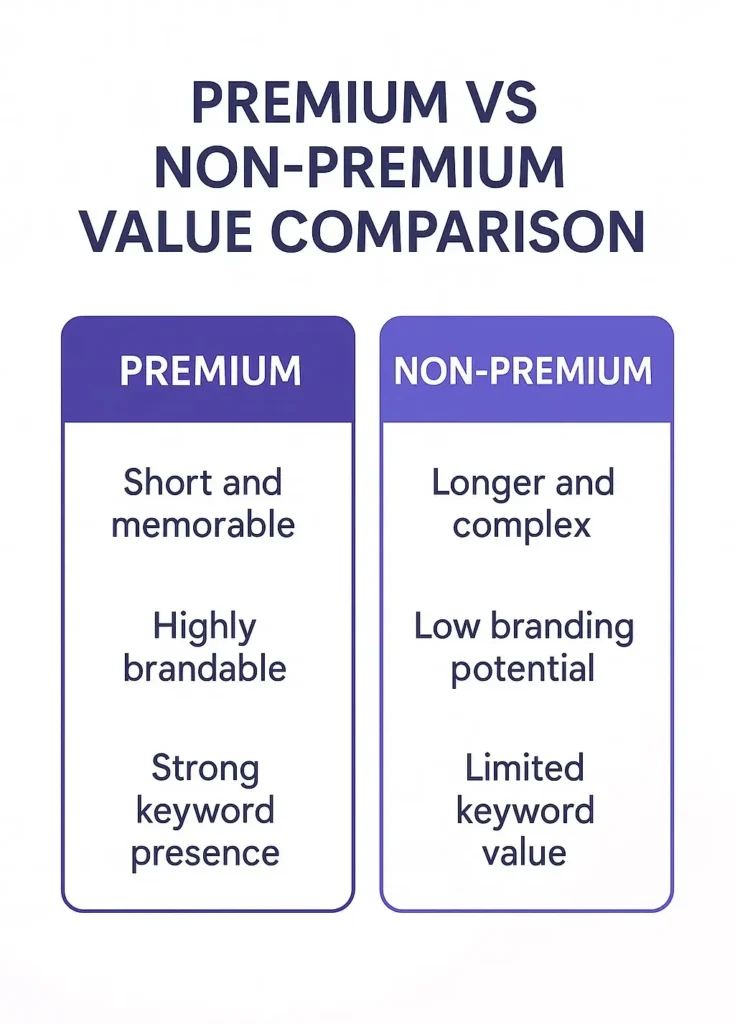
Domains that sell for $10,000–$150,000+ usually share 3–6 of these qualities simultaneously:
- short
- brandable
- strong extension
- high commercial demand
- relevant keyword
- wide use-cases
- premium sound
- future trend alignment
These domains are rare—and therefore extremely valuable.
How to Increase Domain Name Value (2026 Strategy)
Domain value is not fixed. You can increase it strategically.
Here’s how:
1. Improve branding potential
Clean landing page → higher perceived value.
2. Use professional presentation
A branded marketplace like DomainInnovate enhances trust.
3. Price within investor-friendly ranges
Proper pricing increases buyer interest.
4. Get a professional appraisal
DomainVerdict lets you validate and correct pricing.
5. Strengthen negotiability
Short descriptions + use-case suggestions increase value perception.
6. Hold premium domains longer
Premium names appreciate yearly.
Real Examples of How Domain Value Changes
Example 1: Short Brandable (.com)
“Zentro.com”
→ $15,000–$40,000 range
Example 2: Keyword Domain
“CryptoExchange.com”
→ $25,000–$150,000+
Example 3: Weak Brandable
“TechSolutions247.com”
→ near zero resale value
Most people misjudge domain value because they focus on the wrong attributes.
What determines domain name value?
Brandability, TLD, length, market demand, comparable sales, and commercial use-cases.
Are shorter domains more valuable?
Yes. Short domains are more memorable, more brandable, and more scarce.
Do premium domains increase in value?
Yes. Premium domains historically appreciate over time.
How do I check my domain’s value?
Use a structured appraisal process or a hybrid tool like DomainVerdict.com
Why are .com domains more valuable?
Universal trust, global recognition, scarcity, and long-term usage patterns.
Domain Name Value Is Predictable When You Understand the Framework
Domains are digital assets whose value is determined by:
- brand potential
- market demand
- linguistic strength
- scarcity
- comparable sales
- industry fit
- long-term relevance
When you understand the factors behind domain value, you can:
- buy smarter
- sell at higher prices
- build stronger brands
- avoid overpriced names
- spot undervalued opportunities
To get an accurate, professional valuation:
👉 Get a domain appraisal from DomainVerdict.com
And to acquire premium brandable domains:
👉 Browse DomainInnovate.com